


Thanksgiving is behind us, Black Friday is here, and the ghosts of October’s cyber crisis are shapeshifting into a dedicated threat.
October brought a frightening wave of security vulnerabilities affecting software used by millions of websites and applications. Meanwhile, increasingly capable artificial intelligence systems are helping attackers automate intrusions faster than many organizations can respond.
The IT industry called it “Black October.” Rather than running away scared, we decided to do something about it.
Our team at PrivacySafe Foundation has released 86 free security scripts addressing 217 documented vulnerabilities across 85 software projects, plus nine additional security incidents. We’re also developing tools to investigate AI-driven attack frameworks, including ARTEX, which recently prompted a warning from the FBI.
We’ve been busy all over the globe, speaking at international cybersecurity conferences and bringing live cybersecurity demonstrations to hundreds of learners.
While everyone else is hunting for Black Friday bargains, we’re still giving away our cybersecurity tools for free.
Here’s what we’ve been up to this autumn!
🛡️ Free Security Tools for a Dangerous Internet
You probably don’t spend much time thinking about PHP, Python, nginx, or the software running your favorite websites. But a tremendous amount of the Internet depends on these technologies, and the past several weeks have brought some particularly nasty surprises.
One of the biggest was PHP2Shell, a group of serious vulnerabilities affecting certain PHP server configurations. PHP helps power nearly 70% of websites worldwide, including popular platforms such as WordPress and Drupal.
Not every PHP website is vulnerable to PHP2Shell, but a particularly frightening development has been the growing collection of security vulnerabilities with names ending in “2Shell.” Cyber attacks utilizing these exploits open a “shell,” a terminal session where they can execute code and do nasty things to the server, potentially taking it over and even joining a botnet that attacks other websites.
Throughout this fall season, we’ve continued to adapt to this ever-evolving series of exploits. Our security tools now cover PHP2Shell, Plex2Shell, Broccoli2Shell, Upload2Shell, XSS2Shell, and wp2shell, Java4Shell and nginx2root.
Despite their similar names, these aren’t all the same vulnerability. Whatever they’re called, they illustrate a serious problem: ordinary-looking websites and applications often depend on vulnerable components that users know nothing about.
We believe that privacy is a public good. If you have a techie friend, sysadmin, or website host and want to help them get ahead of these threats, point them to our tools and give them an early holiday gift that should make their jobs defending your data easier.
Our latest security collection includes checks for AI agentic frameworks that the FBI has warned about, including ARTEX, CAIRN, CyberStrikeAI, HexStrike AI, and PentAGI. That work has been publicized throughout the security industry, and our team will continue building and improving the safeguards we need for our own users, sharing them widely so that the world can also be safer and more secure.
The monsters may still be out there, but at least we’ve got a few more ways to fight back. 💪
🌏 PrivacySafe Takes the Stage at ISACA in Australia
While our developers were busy fighting security vulnerabilities, PrivacySafe Foundation Vice President Sheree Ip was representing our team on the other side of the world.
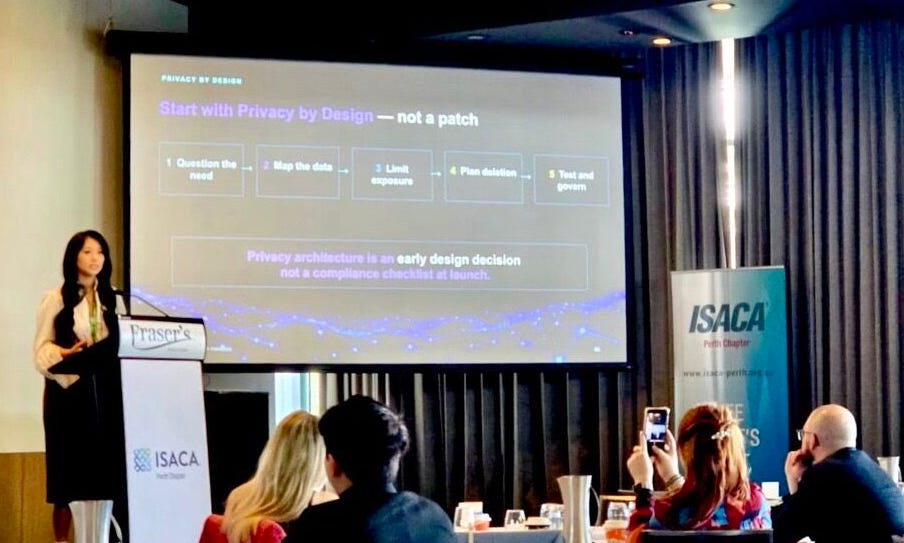
Sheree delivered a keynote presentation at the ISACA SecureIT conference in Perth, Australia.
Her presentation, The Privacy Paradox: Can Blockchain Keep a Secret?, explored the tension between blockchain’s permanent public records and our expectations of privacy.
Blockchain technology is often promoted as a revolutionary way to establish trust, but that transparency can become a serious problem when personal information is involved.
Once sensitive information is recorded on an immutable public ledger, removing it may be practically impossible. There are ways, however, to build technology that takes advantage of the strengths of blockchain while preserving privacy.
Sheree discussed privacy-conscious approaches including zero-knowledge proofs, selective disclosure, and techniques for keeping sensitive information off public blockchains.
The ISACA conference brought together cybersecurity professionals, researchers, and technology leaders to discuss emerging threats, digital identity,and financial technology.
Our team is serious about privacy and security principles, and they guide our work around the globe, whether that is in Australia or the United States.
Privacy should be built into technology from the beginning, and the knowledge needed to secure our systems should be shared rather than locked away. We live these values through our actions, as well as through the solutions we ship for our users.
🌐 Aaron Swartz Would Be 40. Who Profits From His Legacy?
November 8 was Aaron Swartz Day, remembering the programmer, activist, and free software pioneer who helped shape the modern Internet.
Swartz, who died by suicide in 2013 at the age of 26, would have turned 40 this year. At the time, he was the subject of an aggressive federal investigation for his attempts to share knowledge to the public.
His contributions to technologies like Markdown, RSS, and Python web development remain enormously important, particularly as some of the world’s largest technology corporations build proprietary artificial intelligence systems using many of those same technologies.
Sean O’Brien, who leads the PrivacySafe Foundation and separately serves as deputy director of the Free Software Foundation (FSF), recently wrote an article for the FSF that examines a troubling contradiction.
In 2011, Swartz faced federal prosecution after downloading millions of academic articles from JSTOR through MIT’s network. He believed scholarly knowledge should be accessible to everyone rather than locked behind expensive subscriptions.
Today, corporations developing proprietary large language models have collected enormous quantities of books, articles, websites, and public conversations, without permission from their creators.
Anthropic agreed to a $1.5 billion copyright settlement in 2025, while Meta has faced lawsuits involving allegations that it downloaded millions of books and academic publications.
Reddit, a platform Swartz helped build, now licenses access to user-generated content to companies including Google and OpenAI.
The contrast is striking. Swartz faced the possibility of decades in prison for attempting to share academic knowledge, while corporations have built multibillion-dollar businesses around collecting and commercializing human knowledge.
The article was also picked up by Slashdot, bringing the discussion to a broader technology audience.
Swartz’s contributions continue to shape the Internet in profound ways. The companies benefiting from his legacy should respect the principles of sharing, collaboration, and user freedom that made those technologies possible.
💻 Friday the 13th: AI Chatbots, Ultrasonic Trackers, and a Live Cyberattack!
Friday, November 13, turned out to be a particularly appropriate day to talk about cyber incidents. Bay Path University hosted its 14th Annual Cybersecurity Summit, Cybersecurity & AI: Preparing for an Unpredictable Future, bringing together cybersecurity professionals, educators, learners, and community members for discussions and live demonstrations.
And we started early. In the morning, approximately 200 high school learners joined us for a special cybersecurity program.
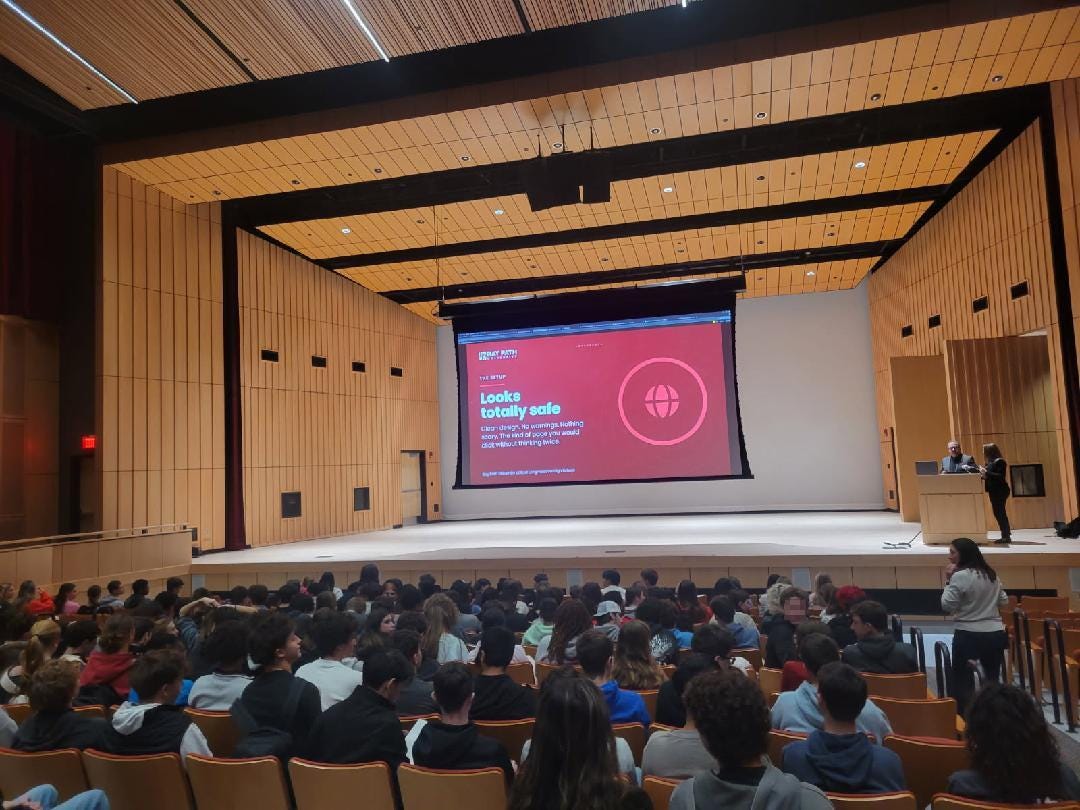
We demonstrated an ultrasonic tracking technique, showing how sound frequencies outside the normal range of human hearing can be used to identify or track devices.
People usually associate surveillance with cameras, microphones recording conversations, or online tracking cookies. But devices can also communicate identifying information in ways that aren’t immediately obvious to their owners.
The demonstration made an important point: just because you can’t see or hear the attack happening doesn’t mean your devices aren’t “talking” to an attacker.
Our featured speaker, Mike Wilkes, Chief Information Security Officer at Aikido Security and former cybersecurity executive at Major League Soccer, Marvel, and Macy’s, joined the morning program for a question-and-answer session with the learners.
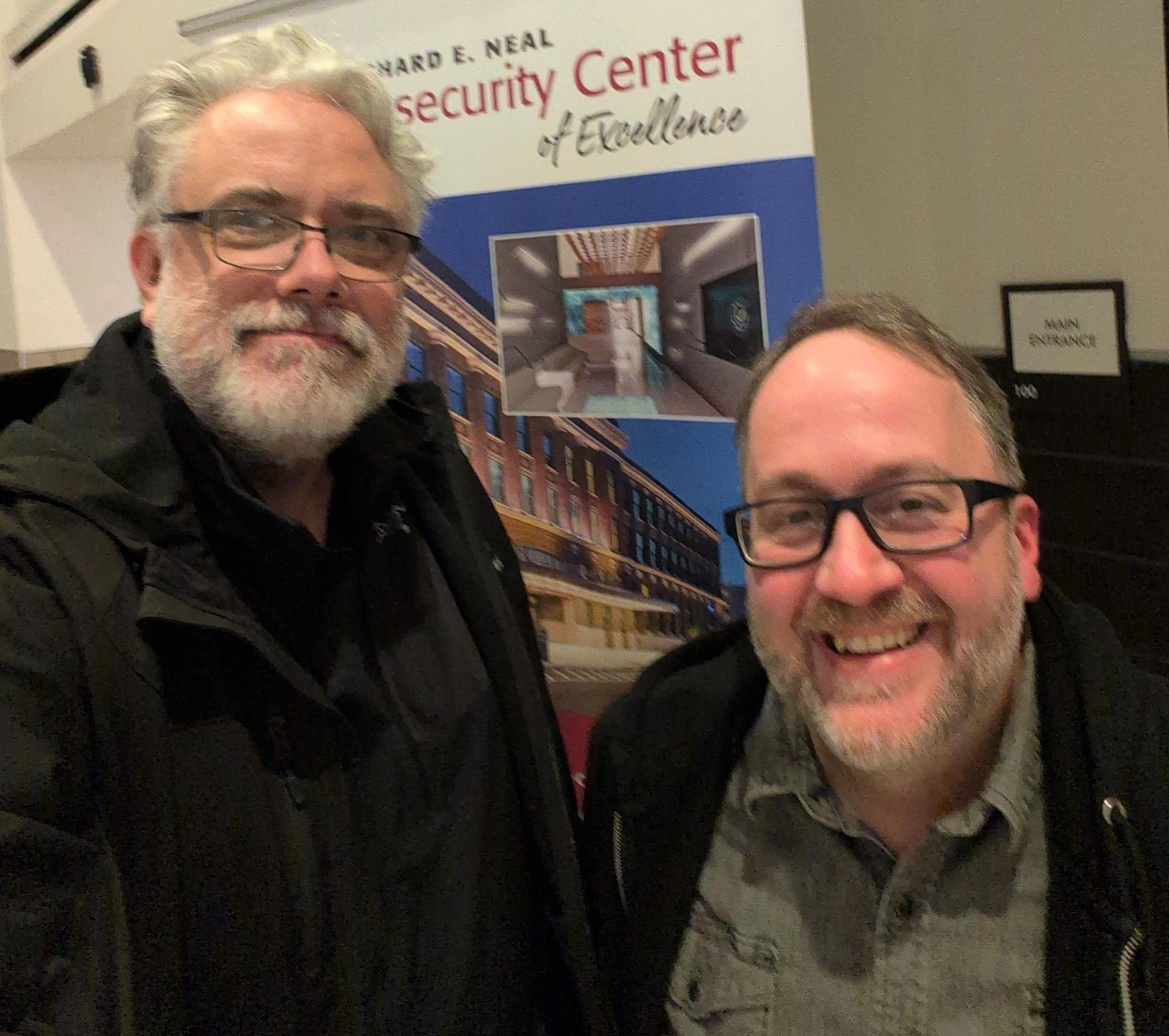
Wilkes has helped protect organizations including Sony, ASCAP, and ING Bank. He also teaches cybersecurity at New York University and Columbia University.
The afternoon summit featured an excellent lineup of speakers discussing emerging threats, cybersecurity careers, organizational resilience, and the growing influence of AI.
But we also wanted to show what some of these threats actually look like. So the event featured a deliberately vulnerable demo server and invited the audience to interact with an untrustworthy AI chatbot. The chatbot was hosted at a website O’Brien created specifically for the occasion.
Participants could type messages into the chatbot interface, just as they might when using one of the increasingly popular AI assistants offered by major tech companies.
Then came the frightening part: the demo “attack” was modeled on a PHP2Shell-style server compromise, with the attacker gaining access to the underlying system.
The chatbot looked like a private conversation, but the compromised server exposed everything users shared with it.
Although this was a controlled demonstration using a server configured for the occasion, the underlying lesson was real. When you type sensitive information into an AI chatbot operated through a centralized “cloud” service, you’re relying on the people running that service to protect both the application and the infrastructure behind it.
There’s tremendous excitement about increasingly capable AI systems, but the fundamental cybersecurity lessons still apply.
Our thanks to Mike Wilkes, the speakers, organizers, participating schools, and everyone who joined us for another successful Bay Path Cybersecurity Summit.
Friday the 13th may have come and gone, but the cybersecurity lessons are worth remembering.
🍗 Our Thanksgiving Gratitude
As Thanksgiving weekend continues, we want to thank everyone who’s helped make our work possible.
The developers contributing to our free software projects, the researchers sharing their findings, the educators introducing young people to cybersecurity, and the volunteers supporting our community all play an important part.
We’re particularly grateful to everyone who believes privacy and cybersecurity should be accessible to everyone.
If our work has helped you stay safe, please consider donating. Your donations go toward a nonprofit and are likely tax-deductible in the US.
While Black Friday brings plenty of sales pitches, our security tools don’t come with a price tag or a limited-time offer. They’re free, and they’re staying that way.
Thanks for reading, and happy Thanksgiving weekend from our team!
🙏 Thank You For Reading!
Bits On Tape is published by PrivacySafe Foundation, a 501(c)(3) nonprofit public charity dedicated to making privacy, cybersecurity, and technology education accessible to everyone.
We’re developing Free/Libre and Open Source Software (FLOSS), publishing independent research, and sharing practical tools and knowledge to help people protect their privacy and security.
You can also join PrivacySafe Social to follow our latest investigations, security releases, and community projects.
🌍 Find Us Around the Web
We’re getting our message out on:
🌞 PrivacySafe Social: @bitsontape
• Telegram: Bits On Tape
• Blue Sky: @bitsontape.com
• Twitter X: @BitsOnTape
• LinkedIn: Bits On Tape
© 2026 PrivacySafe Foundation, Inc., a 501(c)(3) nonprofit public charity. Bits On Tape is a publication dedicated to privacy, cybersecurity education, and Free/Libre and Open Source Software (FLOSS). PrivacySafe® and 3NWeb® are registered trademarks. PrivacySafe Foundation™ and Ivy Cyber™ are pending trademarks. PrivacySafe products and services are offered by Ivy Cyber LLC. All original content, unless otherwise noted, is licensed under Creative Commons BY-SA 4.0 International.